Sunday, October 10, 2010

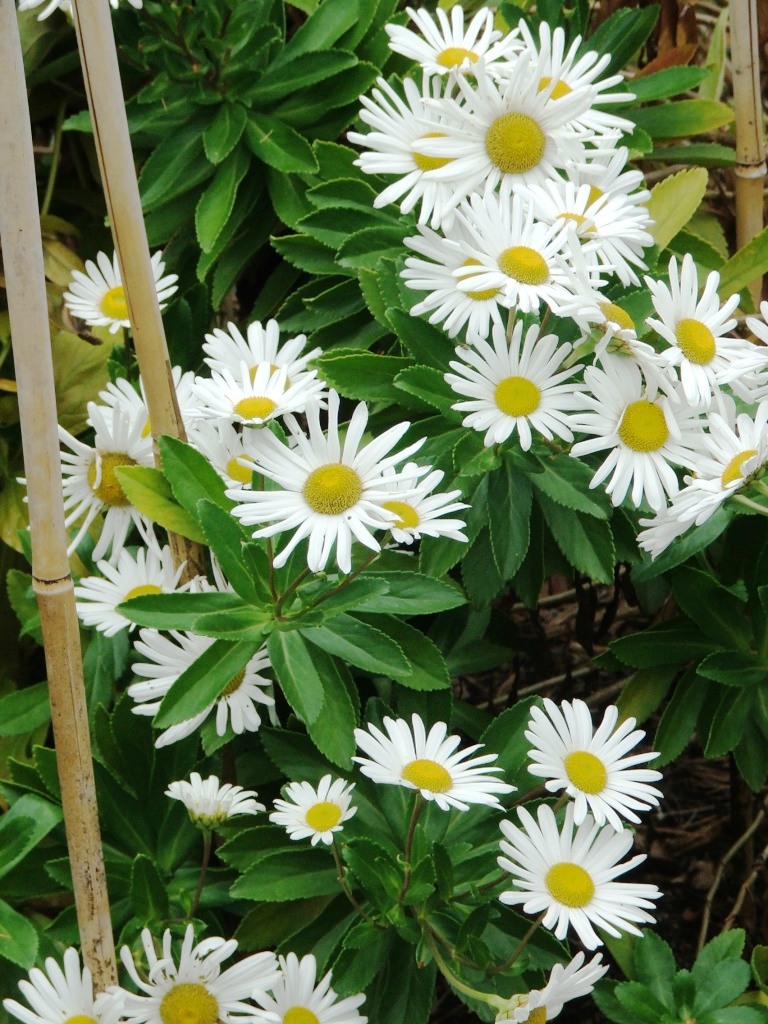
Montauk Daisies, Nippon Daisy… Nipponanthemum nipponicum


Mother Nature saved some of her best work for the end of the growing season with the Nippon Daisy. Also commonly called the Montauk Daisy (because it is commonly found on eastern Long Island), its Latin name, Nipponanthemum nipponicum, makes it pretty clear that this plant is native to Japan (Nippon). Plant lovers may also know it by its former Latin binomial, Chrysanthemum nipponicum. By its current classification, it is the only member of its genus, one of 477 genera in the Aster Family. So much for the nomenclature.

Almost precisely one year ago, I was on a busman’s holiday in Rhode Island, looking over the Kathleen Mallon Memorial Demonstration Gardens on the campus of the University of Rhode Island. They are created and maintained by Master Gardeners in that state and named for an Extension Educator who was instrumental in launching the Master Gardener program there. I was knocked out by the brilliant white show of flowers from Nippon Daisy. My plant pal, Mary Jane, quickly identified it and told me that they were as common as clams in Rhode Island. Then I started noticing them everywhere in Costal New England.

Back home, the Nippon Daisy faded from memory until I was in a very good local garden center this summer and asked if they had ever heard of them. I don’t see them used much in SE PA. The plantsman at the garden center agreed but said he was beginning to get inquiries about it. Sure enough he had a few containerized plants and they are now lighting up my fall landscape.

Nippon Daisy is hardy in zones 6-9 and is a rugged plant. It tolerates dry sites, does best in full sun and makes its floral display late in the growing season. It will grow about three feet tall and wide and requires some simple/easy pruning for best performance. They can become “leggy”, that is, produces naked stems but with a bit of pruning the plant can be kept a bit more compact. Plan to cut them close to the ground each spring. Most landscape design advice is to plan for something that grows a bit lower in front of Nippon Daisy to hide its bare legs as the season progresses. Some references say deer don’t care much for it and it has stood up to a modest test in my landscape. The floral display beings in late summer and lasts late into the fall. White is the word. Maybe it is the contrast of white with the reds and golds of our fall foliage that makes it so attractive. Makes a good cut flower, too.

Reading about this plant, I learned that the famous plant breeder and legendary, pioneering geneticist, Luther Burbank hybridized this species with other closely related species to create Shasta Daisy and other popular cultivars which we still enjoy. Apparently, it was the brilliant white that made him choose Nippon Daisy for his work.

It seems that my revelation about Nippon Daisy would cause a chuckle among coastal gardeners but until I see more of them in Pennsylvania landscapes, I will continue to talk up this great plant.

It’s not too late to search for this fantastic daisy in local garden centers. Call it Montauk, Nippon or Nipponanthemum nipponicum, this plant is worth a look if you are in the market for an outstanding fall bloomer for a hot, dry site.

Friday, August 13, 2010

New Backyard Vegetable Publication from Penn State


Who said there is nothing new under the sun? Penn State just published a new, 58 page guide to backyard vegetable production titled Vegetable Gardening… Recommendations for Home Gardeners in Pennsylvania. It contains sections on mulches, container growing, irrigation and other cultural practices. Following this, there is a separate discussion of key plant groups: Brassicas (cabbages), root crops, bulb crops, leafy vegetables, tomato/eggplant and others.

There is information on seed starting, planting dates, spacing, pest management and harvesting…. everything beginning gardeners need to begin a successful garden. Seasoned gardeners are sure to pick up a few new ideas as well.

Dates described in the guide refer to central Pennsylvania. Those of us in the southern part of the state can adjust suggested dates about 10 days at both ends of the growing season. So, the gardening season is not over! Lettuces, turnips, radish are just a few of the tasty crops we can seed or transplant this month. With season extending rows covers we’ll be gardening until Thanksgiving.

Vegetable Gardening… Recommendations for Home Gardeners in Pennsylvania distills the knowledge of more than dozen Penn State experts and was organized by associate professor of Horticulture, Elsa Sanchez. You can order a copy or simply read it on line by going to this site.

Wednesday, August 11, 2010

Summer Color with Crapemyrtles


Most of the flowering trees and large shrubs we admire in the landscape are spring bloomers. Think dogwood, cherry, magnolia….crabapple, pear, serviceberry….redbud, lilac and viburnum.

So, stunning summer flowering trees are a treat for the eyes. One of the most conspicuous small trees/large shrubs that I see at this time of year is Crapemyrtle, Lagerstroemia. Common flower colors are shades of pink and red but white cultivars exist. In addition to the showy flowers, Crapemyrtle bark is very attractive…shades of cinnamon brown and gray that exfoliates with age. One respected plantsman says “If Crapemyrtle never produced flowers or leaves, it would not be a bad thing.” That’s high praise for bark characteristics.


One reason Crapemyrtle is somewhat unusual in Pennsylvania landscapes is its hardiness. Unless you are in zone 6 or 7 it won’t survive. Even in zone 6, expect dieback to the ground in severe winters. What has helped make Crapemyrtle more popular is a breeding program from the National Arboretum which added both winter hardiness and disease tolerance from Lagerstroemia fauriei to Lagerstroemia indica, resulting in about 20 wonderful hybrids. These cultivars, developed by Dr. Donald Egolf, all have Native American tribal names, so they are easy to spot. Tuscarora, Natchez, Hopi, Sioux, etc. A list of National Arboretum selections and a thorough description will guide you to good decisions.

Aside from being marginally hardy for parts of Pennsylvania, the plant is tough as nails. Yea, Japanese beetles like to chew on them and reference books describe other pests… but nothing life threatening. Crapemyrtles thrives in hot spots and tolerate poor soil. Full sun exposure is best.

So, if you have a hot spot in the landscape that can accommodate a multi-stemmed tree/shrub which will mature between 10 and 20 feet, and you would like a splash of bright color in the landscape in mid-summer, think Crapemyrtles. Start with the National Arboretum selections and beware of hardiness requirements. I counted more than 60 cultivars in my reference books, not all of them are appropriate for Southeastern Pennsylvania.

Wednesday, July 7, 2010

Growing Great Garlic


I won’t fake modesty here. I grew some great garlic. You can, too. It’s easy.

The garlic heads pictured here were harvested over the July 4th weekend… just a bit earlier than normal in this hot growing season.

I grow hard neck garlic, Allium sativum var. ophioscorodon, also known as ophio garlic, serpent garlic, top setting garlic, and echte Rokkenbolle or Schlangenknoblauch (to my German friends).

Hard necks produce a reproductive structure called a “scape”, a firm stalk ending in a swollen capsule which contains bulbils, not flowers. The scapes are quite tasty themselves, if harvested when they snap easily from the plant in mid spring.

Hard necks are different from the soft neck garlic you get in the grocery store. Hard necks have a shorter shelf life, fewer (but larger cloves) and for many people, have better, bolder flavor. As the name indicates, soft necks have no hard stem. They braid nicely. Most of what you see in the grocery store are softnecks, grown in China.

Oh, it gets even more complicated than this with different types of both hard neck and soft necks. And the names given to local selections of each type muddies the water even further. Recently, USDA researchers have concluded that there are actually many fewer garlic varieties than the common names would imply. Local adaptations and response to environment account for the perceived differences. For a great read on garlic, consider the text, Growing Great Garlic by Ron Engeland. It sorts out a lot of the terminology, history and origins of this unique food and provides excellent advice on growing all types of garlic. Penn State’s Growing Bulb Crops publication also has enough info to get you started.


Back to the basics. So, if harvest time is about the 4th of July, when is planting time? Columbus Day…more or less. That’s a good general guide for planting garlic in Pennsylvania. You simply stick a clove, (root end down) an inch or two deep into well prepared, rich garden ground, spaced about every 7 inches. It often makes sense to make a bed and plant three rows together, about 10 inches away from adjacent rows. Cloves will root well and make a few leaves before the soil freezes up. Then mulch with straw or leaves and wait for them poke thru in the spring. Keep the planting weed free. A shot of rich compost or fertilizer in early spring is a good idea.

That’s about it. Garlic has few pest problems besides weeds. A few hand weedings, as the mulch deteriorates, is necessary. When to harvest is an important consideration. Too early and clove size and maturity is reduced. Too late and cloves separate within the head and quality and shelf live diminish. I have followed Engeland’s advice and harvest my Ophios when 40 % of the lower leaves have died, leaving about 6 green leaves at the top of the plant at the time of harvest. Your goal it to have well segmented cloves that have not begun to separate within the head. This is usually about mid-July for the varieties I grow.

Post harvest care is important. I move my harvested garlic immediately to a shaded, well ventilated area to “cure”. Although many folks seem inclined to let it lay out in the hot sun, this is not the best approach. Since most of it is consumed by Christmas, no special storage is required. Most references say to store garlic at 55-65 degrees F and 50 % humidity. So a cool cellar, or similar space, will work very well.

Note that you’ll likely be saving some of you own crop as “seed”. Not literally. You’ll save some heads that will be broken into separate cloves for planting in October. So if you happen to harvest some over mature heads, they make good planting stock. Or, just eat them first.

Of course you have to get started somehow. Where do you get planting stock? Your best bet may be a local farmers market that is selling their own, farm grown garlic. This will obviously be well adapted to your area. If this doesn’t work, the internet is full of sellers in the Northeast US. Don’t plant store bought garlic. It is unlikely to be well adapted to our growing conditions.
I still have a lot to learn about garlic. I’d like to try some soft necks. Add a few more hard necks. But the important things I have learned are that hard neck garlic is easy to grow, it’s better tasting than store bought and it keeps well until Christmas (and beyond). Give it a try this fall.

Friday, July 2, 2010

Getting Dry... Good, Bad and Ugly


OK getting dry might be an understatement. It is DRY in Bucks County, PA. When I see roadside weeds wilting, it’s dry. And today’s newspaper says, “Hot and dry with no rain in sight”. I think that means no rain in the forecast. Sure enough, the 7 day forecast is bone dry.

Let’s start with the good aspects of dry. My farm friends (who have irrigation) tell me that they will take a dry year over a wet one anytime. It is possible to add water but impossible to take it away. Heat and sunshine combined with timely irrigation equals wonderful tomatoes, peaches and other produce. Sure they have the chore of moving pipes and running pumps but they have control of the water. Same thing goes for home gardens.

And that late blight problem we are watching… it's gonna have trouble getting cranked up in these conditions. Notice how the sycamores have leafed out again after the ravages of early season leaf diseases. Thank the dry heat.

The bad…I think most folks underestimate the damage water stress causes to plants. Especially woody plants. It’s pretty obvious when you neglect to water the petunias or tomatoes. They wilt and probably recover when watered; if not, they die and you move on. In any event, they are annuals so you get another chance at minimal expense. With woody plants, the effects of drought are often harder to see and the effects may take awhile to manifest themselves. Often times it is borers, or even disease, that finish off these drought stressed plants. It may take years.

Just for fun, I observe lots of new landscape plantings. New housing developments, commercial sites, even the grounds of our Extension office. Frequently (if not usually) the newly established trees and shrubs are subject to severe drought stress in the first 12 months of planting. When they can least tolerate it. It is good to recall that these plants arrive to the site with a severely diminished root system. A lot of it was left behind in the nursery when the plant was dug. Even containerized plants have an abnormally restricted root system. Believe it or not, sometimes the plants that are established on these job sites arrive already drought stressed. Dormant plants that don’t “ leaf out” normally are suspect in my eyes.

OK. What does this mean? Right now, trees and shrubs that were planted within the last 12 months need water. If you wait until leaves wilt and fall off you have waited too long. Anticipate the watering needs of these plants and give them a good soaking before they wilt. Check back in a week and repeat if necessary. A good soaking is hard to quantify. How about this… 5 – 10 gallons per tree, applied at the base of the plant, slowly so that it soaks into the ground. Repeat weekly as needed. This requires a hose and some time. A watering can won’t cut it. Mother Nature will eventually come to our aid but until them, make a date with your trees and shrubs weekly. That green thing shown above is a "gator"; an irrigator bag. A handy device that allows the bag to drip water into the soil at a nice, slow rate, but you can fill it quickly.

The ugly…of course, complete neglect in a drought results in dead plants. Maybe not dead now but drought stress can show up as “winter injury’, borer damage or even disease in the long run. Going on vacation? How about a good soaking before you head off. The trees, not you.

Finally, although it is hard to imagine in a drought, it is possible to have too much soil moisture. You can over water. Automatic irrigation systems (improperly manage) kill plants.

Wouldn't it be wonderful if it rained an inch a week, every week, preferably between midnight and dawn. There are places in the world where temperatures and rainfall regular and predictable, within the growing season. Pennsylvania isn't one of them.

Monday, June 14, 2010

Late Blight Rears Its Ugly Head Again


Late blight, the disease that wrecked many gardeners’ dreams of a fresh tomato sandwich last year, has been found, wide-spread, in western Pennsylvania. Many horticulturists, me included, were optimistic that we would be spared in 2010 but that hope now appears to be dashed. At this time, late blight has only been confirmed in three western PA counties but all Pennsylvania tomato and potato growers need to be vigilant. For a good discussion of the disease including images, see this site; or this site
To recap…. Late blight is a devastating fungus-like disease of both tomato and potato. Symptoms include rapid blighting of foliage and fruit. Tomato stems exhibit chocolate brown lesions. Leaves have blotchy brown spots and may produce fuzzy, whitish masses on the underside of leaves, especially in the morning when dew is present. Note that this is very different from early blight which results in yellow-brown lesions on lower leaves, containing concentric rings of dead tissue.

What’s a gardener to do? First, be vigilant. Inspect tomatoes and potatoes daily for late blight symptoms. Penn State will be tracking the disease in an attempt to alert commercial growers about the threat of late blight in their vicinity. It’s one thing to miss out on a tomato sandwich…quite another thing to lose a big chunk of your income. Farmers have a lot at stake with a crop of tomatoes or potatoes. Contact your extension office if you think you see late blight. Feel free to bring samples to the office for confirmation of the disease.

How about protecting those plants? Conventional gardeners and farmers can use products containing chlorothalonil, for starters. New foliage needs to be protected as it grows. Organic gardeners have copper fungicides, which will not provide the same level of protection as chlorothalonil but are better than nothing. If you plan to let Mother Nature take its course, and do nothing, at least be prepared to destroy infected plants at the first sign of disease… your neighbors will thank you. Best bet in small gardens is to bag the plants in plastic and cook them in the sun.

Any chance we’ll escape late blight in eastern PA? I was an optimist in the winter because it is known that the organism does not survive without living tissue in the North and Old Man Winter took care of that (except for potato cull piles) . But now that the cat is out of the bag…. I think we’re in for another year of greasy, black fruit in the tomato patch.

Dang… I was feeling good; tying up plants in the rain yesterday. Now I wonder if those raindrops were accompanied by late blight spores. Current conditions are ideal for late blight infection.

Monday, May 17, 2010

Beautiful Gardens... Near and Far


In the past month, I have visited two of the best public gardens in the world….one in our backyard, Longwood… the other across the Atlantic, Keukenhof. Lucky me.

I was in the Netherlands visiting family in early May and it was tulip time at Keukenhof. Perfect timing. Keukenhof is a 76 acre garden that features spring flowering bulbs. Supported by the bulb industry, their website says it is the most photographed place in the world. I can believe it. Every step through the garden compels you to snap another picture. With all due respect to Longwood, it is the best public garden I have ever seen. There are more than 7 million hand planted bulbs on display. Four million tulips, not to mention the daffodils and grape hyacinth… 20, 000 lilies.


Wow. If you ever find yourself in Europe in April, don’t miss it.

Back at work… Penn State President Graham Spanier conducts a very nice program for new and newly tenured faculty at Penn State called the Roads Scholars Tour. About 50 faculty witness Penn State’s presence and impact across Pennsylvania. They visit Commonwealth Campuses (there are 19 of them across the state), Hershey Medical School and other places where Penn State has had an impact. This brings us to Longwood Gardens. There are lots of Penn State graduates on the staff here and I learned about many cooperative research ventures involving Penn State and Longwood. My pal Dr. Casey Sclar, Plant Health Care Division Leader at Longwood led the Roads Scholars and President Spanier on a great tour of this world class garden. Casey said Longwood was about to present the largest lily collection in the world. I guess there will be more than the 20,000 at Keukenhof. Yikes!


Unlike Keukenhof, Longwood is open 365 days a year. What a challenge for the horticulturists there. If you have not visited lately, put it on your “to do” list.